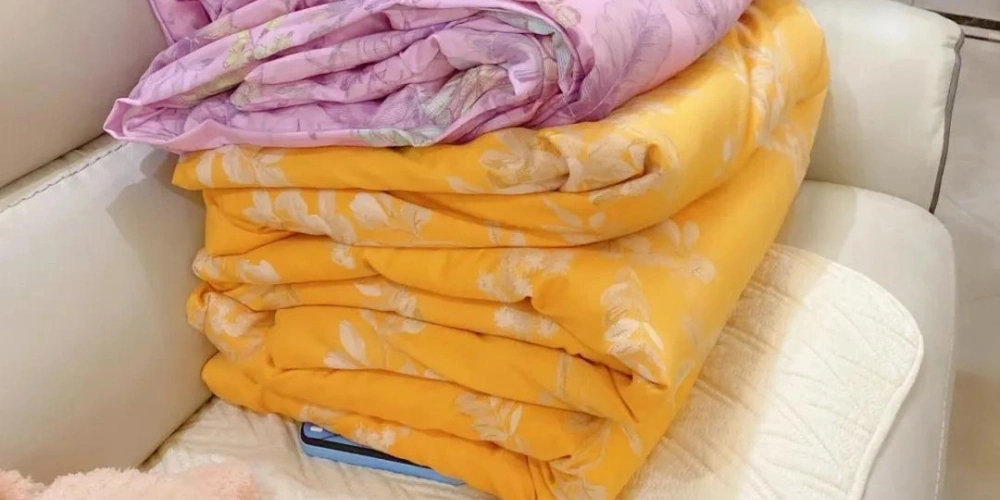
A Guide to choosing quilt covers
The quilt cover and the bed cover are among the bedding items that come into contact with our skin the most. In terms of touch, more attention is paid to the material. Moreover, the inner tube of the cotton quilt is not easy to be replaced frequently, so the quilt cover needs to complement each other to achieve the highest level of comfort. This article will help you better understand the importance of quilt covers through various tips for choosing them.
It is essential to know the differences between bed bag sets and duvet covers
The bed is one of the bedding items we come into contact with every day, especially the pillow, quilt and bed sheet which are closest to the skin. Therefore, comfort and material are of great importance. What you usually see on the market are pre-made bed bag sets, which include one bed bag, one duvet cover and two pillowcases. This can make the bed more thematic and you don’t have to worry about how to match them.
Quilt covers are only used for “cotton quilts” and are divided into two types: “thin quilt covers” and “dual-purpose quilts”. The difference lies in that thin quilt covers only have a thin layer and are not covered with cotton. They need to be inserted into the quilt body to be used. The dual-purpose quilt contains a cotton layer. It can be used as a cooling quilt in spring and summer, and the quilt body can be added in autumn and winter to enhance the warmth.
The spare tire must be added for spring and summer: no need to be added for autumn and winter: (to increase warmth)
Whether you want a bed cover set with a complete style or to purchase a single one, it all depends on your personal needs. Next, we will guide you on how to buy a suitable quilt cover for yourself, so that you won’t be confused that a dual-purpose quilt cover is also a type of quilt cover.
6 Tips for Choosing Duvet Covers
The quilt cover is one of the bedding items that come into prolonged contact with the skin, and comfort will be one of the important considerations. The following 6 purchasing tips will help you quickly find the right quilt cover:
Duvet cover selection tip 1: Season
The temperature of the weather usually affects one of the reasons why we want to cover ourselves with a thick quilt or a thin one. The main distinction can be made between summer and winter. In summer, the focus is on whether the quilt cover has good moisture absorption and ventilation to help those who have fallen asleep enjoy a good sleep quality in the hot summer. In winter, the focus is on the warmth retention effect. It is recommended to choose materials with a constant temperature effect or dual-purpose quilts with a cotton layer, which will help improve the warmth retention effect.
Duvet cover selection tip 2: Material
To achieve a comfortable sleep that is warm in winter and cool in summer, the material of the duvet cover is the second most important consideration after the spare tire. If the duvet cover is a warm down quilt but the touch of the duvet cover material is not good, it will affect the overall sleep quality. Here are several common duvet cover materials for your reference:
Pure Cotton (Cotton) : It has excellent moisture absorption and breathability, is less likely to cause a stuffy feeling, has a soft touch, is washable, and has a moderate price. It is the first choice for most people.
Linen: It has a slightly better moisture absorption than pure cotton, a light and thin touch, and is less likely to stick closely to the skin. It is especially suitable for use in summer, providing a cool and comfortable feeling.
Tencel: It can be divided into three types: Lein, Modal, and Lyocell. It is a type of natural material, but the raw materials used are different. Moreover, Tencel is a brand name of the Austrian company Lenzing, not an ingredient name. Therefore, when looking at the ingredient label of bedding, only Lein, Modal, or Lyocell will be displayed. Nowadays, the Tencel seen on the market is mostly represented by Lyocell. The following is a brief explanation of the differences among the three:
Rayon: The raw material is derived from wood chips and needs to be artificially processed. It is a regenerated fiber with excellent moisture absorption, combining the breathability of cotton and the luster of silk. However, Leying is prone to wrinkling and is likely to shrink when washed.
Modal (Model) : The raw material is recycled beech wood. It is softer, more moisture-absorbent and breathable than leying, but it has poorer stiffness and is prone to deformation.
Lyocell: Its raw materials are sourced from beech, birch, spruce, etc., and it is also made from wood pulp. It has a smooth touch and is very skin-friendly. It can not only regulate moisture and release it, but also has better breathability and moisture absorption than all materials.
Silk: It has good air permeability and warmth retention. Even without a thick winter quilt, it can achieve a perfect constant temperature effect and has a smooth touch. However, its price is much higher than that of pure cotton and Tencel.
Nylon: A type of polyester fiber, it is wear-resistant, durable, elastic, and has a smooth touch. However, it is not heat-resistant or breathable, and is prone to staining.
Polyester: Its breathability and moisture resistance are among the poorest of all materials, but it is highly durable, elastic, and not prone to shrinkage. It dries quickly without wrinkles.
The moisture absorption, breathability and functionality are suitable for the season
Pure cotton has no four seasons
Flax is excellent for anti-allergy in spring and summer
Tiansi Youyou anti-mite and antibacterial for all four seasons
Silk is good for keeping warm in autumn and winter
Nylon has no autumn or winter
Polyester fibers have no four seasons
Duvet cover selection tip 3: Size
The size of cotton quilts is usually larger than that of mattresses and is mainly divided into three types: single (4.5 X 7 feet), double (6 X 7 feet), and King size (7 X 8 feet) (which is different from mattresses). In addition, quilts come in different thicknesses. If the appropriate size of the quilt cover is not chosen, it is easy for the quilt to shift or clump together, affecting the comfort of the sleeper under the quilt and the flatness of the quilt.
Duvet Cover Selection Tip 4: Functionality (Mite-proof, mold-proof
In addition to the comfort level, quilt covers can also take the user’s physical condition into account as a reference value. For instance, people with allergies or children and the elderly with sensitive skin are more susceptible to environmental influences. If a large number of dust mites remain in our bedding, these groups will be the first to notice something unusual about their bodies. It is recommended to choose duvet cover materials that are mite-proof and antibacterial.
Tip 5 for choosing quilt covers: Convenience
Because the size of the cotton quilt is relatively large, it often takes some time or requires the cooperation of two people when changing it. At present, most quilt covers use zippers as switches. They can be divided into one side fully opened to form a ㄇ shape, both sides with zippers that can be fully opened, or a smooth zipper hidden in the middle. You can evaluate which method is more suitable for you. In addition to zippers, you can also observe whether there is a fixing mechanism inside the quilt or quilt cover (ropes tied at the four corners, buttons), which can make the quilt body more flat and less likely to form clumps.
Duvet cover selection tip 6: Budget
The price of quilt covers varies depending on their size, material quality, brand, or whether they are dual-purpose quilts. Generally, pure cotton quilts are more affordable, with a price range of around 100 to 1,000 yuan to get a decent quilt cover. If functionality (mite-proof, antibacterial, constant temperature, etc.) is taken into account, the prices range from several thousand to tens of thousands of yuan. It is suggested that everyone can choose the quilt cover that suits them according to their budget and needs.